If your heating won’t come on, or the boiler seems to ignore your settings, the thermostat or controls are often the cause. Many heating problems are linked to simple issues with the thermostat or programmer rather than a full boiler breakdown. Before assuming the boiler itself has failed, it’s worth running through a few safe, easy checks. These quick steps can save you time, money, and a lot of frustration by pinpointing the real problem and avoiding unnecessary repairs.
Simple things like dead batteries, incorrect settings, or lost connections are common and fixable without specialist help. Taking a moment to troubleshoot your thermostat and controls first can help you get your heating back on faster and with less hassle.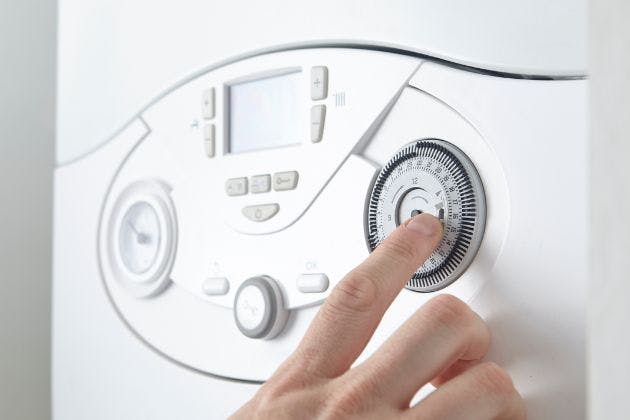
Understanding your heating controls
Modern central heating usually has several different controls working together. If any one of them is set incorrectly or has a fault, your boiler may not respond as you expect.
Getting clear on which control does what will make troubleshooting far easier and help you explain the issue if you do need an engineer.
Room thermostat
The room thermostat measures air temperature and tells the boiler when to fire to reach your set temperature. It might be a simple dial on the wall, a digital unit, or a wireless thermostat you can move around.
If the room stat thinks the room is already warm enough, it will not call for heat, and the boiler will stay off even if you feel cold.
Programmer or timer
The programmer or timer controls when heating and hot water turn on and off. On many systems it is a separate box near the boiler or hot water cylinder, with buttons and a small display.
If the timer is set to the wrong mode, time, or schedule, your heating may not run when you expect it to, even though the boiler and thermostat are working.
Thermostatic radiator valves (TRVs)
TRVs are the numbered valves on individual radiators that regulate heat room by room. They do not control the boiler itself, but they can shut off flow to a room once that space is warm.
If TRVs are turned down low or stuck, some rooms may stay cold and make it seem like the thermostat or boiler is not working properly.
Quick checks before calling an engineer
These simple checks are usually safe for homeowners and can quickly show whether you have a control problem or a deeper boiler fault.
Check thermostat batteries: If your room thermostat or wireless controller has a screen, look for a low battery symbol or faded display and replace batteries if needed.
Confirm modes: Make sure the programmer and thermostat are set to heating mode (often marked as "CH"), not hot water only or off.
Use boost/override: Try a short "boost" or "advance" function to see if the boiler responds when you manually call for heat.
Verify pressure: Look at the boiler pressure gauge; most systems run around 1 to 1.5 bar when cold. Very low pressure can stop the boiler firing.
Test hot water: If you have a combi boiler, run a hot tap and see if the boiler fires. Hot water working but no heating often points to a control or valve issue.
Common thermostat and control issues
If your checks above show the boiler has power and can fire for hot water, the problem is often within the controls. These are some frequent causes that are worth ruling out.
Flat batteries and lost pairing
Wireless thermostats and receivers rely on batteries and a stable signal. Flat batteries can cause the thermostat to lose its settings or fail to talk to the boiler receiver.
If changing the batteries does not help, check the receiver unit by the boiler. Lights or symbols on it may indicate whether it is paired. You may need to follow the pairing instructions in the manual to reconnect the thermostat and receiver.
Incorrect modes and schedules
Many control issues come down to simple setting errors. Make sure:
The programmer is set to the correct day and time, especially after a power cut. If the clock is wrong, heating may come on at odd hours or not at all.
Heating and hot water channels are both set correctly. On some units you can have hot water on but heating off, which can easily be changed by accident.
Thermostat placement and false readings
If your room thermostat is in a very warm or cold spot, it may misread the actual room temperature. Being too close to a radiator, in direct sunlight, or above an appliance can make it think the house is hot when it is not.
Try to avoid placing a portable thermostat on a windowsill above a radiator or near a draught. In some cases, a permanent wired thermostat may need to be relocated by an engineer for more accurate readings.
Smart thermostat checks
Smart thermostats add extra possibilities for control, but also extra things that can go wrong. Before blaming the boiler, check the app and any hub or internet bridge that your thermostat uses.
Look for error messages in the app about lost connection or offline devices. If the hub has lights, make sure they match the normal operating pattern and that the hub is connected to your router.
Signal issues are also common. If the thermostat or receiver is a long way from the hub, or there are thick walls in between, the heating signal can drop out. Moving the hub slightly, avoiding enclosed cupboards, or improving Wi-Fi coverage may restore reliable control.
Control fault or boiler fault: how to tell
A few simple observations can help you work out whether you are dealing with a control problem or something inside the boiler itself.
If the boiler lights when you run hot water (on a combi) but not when you call for heating, that often points to thermostat, programmer, or motorised valve issues. If neither heating nor hot water will fire, the boiler may have locked out or developed an internal fault.
Check for fault codes or flashing lights on the boiler display and listen for the boiler attempting to start. If you see repeated fault codes, unusual noises, or pressure that keeps dropping, it is time to stop troubleshooting and call a professional.
Jobs for a Gas Safe engineer only
Anything that involves opening the boiler case or working on fixed wiring should only be done by a qualified Gas Safe engineer. It is not just a safety issue; it is also a legal requirement for gas work.
Typical tasks that need a professional include replacing a wired room thermostat or programmer, installing or diagnosing motorised zone valves, and testing or replacing the boiler's control PCB. These jobs involve electrical testing and access to gas-carrying parts that are not safe for DIY.
If your basic checks have not solved the problem, or you suspect an issue inside the boiler, you can read more on our Gas Safe engineer services and boiler repair options, then arrange a visit.
Next steps if your thermostat still is not working
If you have checked batteries, modes, schedules, pressure, and hot water operation and your boiler still does not respond properly, the fault is likely beyond simple user settings. Continuing to reset or tamper with wiring can make things worse and may be unsafe.
For clear diagnosis and safe, compliant repairs, contact RDS PLUMBING LTD on 08000282031. A qualified engineer can test your controls, wiring, and boiler to find the root cause and get your heating running reliably again.